class: center, middle, inverse, title-slide # The Effect of Conditional Cash Transfer Policies on Regional Crime Levels: ## Evidence from a Synthetic Controls Framework ### Felipe Santos-Marquez<br /><a href="https://felipe-santos.rbind.io" class="uri">https://felipe-santos.rbind.io</a><br /><br />Research Assistant / PhD Student <br />Chair of International Economics<br />Technische Universität Dresden<br /> Germany ### Prepared for the 2021 60th ERSA Congress <br /><br /> Special session S43:Counterfactual methods for regional policy evaluation<br /><br /> [slides available at: <a href="https://ersa-felipe-santos.netlify.app" class="uri">https://ersa-felipe-santos.netlify.app</a>] --- class: highlight-last-item <style type="text/css"> .highlight-last-item > ul > li, .highlight-last-item > ol > li { opacity: 0.5; } .highlight-last-item > ul > li:last-of-type, .highlight-last-item > ol > li:last-of-type { opacity: 1; } </style> ## Motivation: - large regional inequality between Colombian municipalities and high homicide rates. -- - There is no certainty over the effect of conditional transfers on violent crime, and especially on homicides. -- - Scarce academic literature on the impact of CCT programs on crime at the municipal level in Colombia. -- ## Research Objective: - Which are determinants of homicide rates for Colombian municipalities? - **To what extent the coverage of conditional cash transfer program in Colombia (the pacific region of Colombia) may affect homicide rates?**. -- ## Methods: - Bayesian Model Averaging **BMA** (Fernandez et al. (2001)). -- - Synthetic control methods (Abadie and Gardeazabal (2003)). -- ## Data: - Municipal panel dataset CEDE, released by the University of The Andes. -- - National Administrative Department of Statistics. -- --- class: middle, highlight-last-item ## Main Results: - 15 variables are found to be important determinants of homicide levels. They are related to **crime, inequality, drug-trafficking, conflict and literacy**. -- - The importance of spatial effects is highlighted by the fact that out of 15 variables **9 are spatially lagged variables**. -- - It was reported that by 2018, **the average homicide rates were lower for high CCTs coverage municipalities** when compared to synthetic controls ("copies" made out of a pool of low CCT coverage municipalities). --- # The counterfactual methodology for policy evaluation in one figure -- <img src="figs/flowchart.png" style="width:100%"/> -- $$BMA \rightarrow \space determinants \space of\space Y \rightarrow Synethetic \space Controls \rightarrow The \space impact \space of \space X \space on \space Y $$ --- class: middle, highlight-last-item ## Homicide rates over time <img src="figs/homicides.png" style="width:100%"/> Intentional homicides for selected South American countries and Japan (Source: Author’s calculations using data from the WDI World Bank (2020)) --- .pull-left[ ## Colombian administrative levels ## States and Municipalities 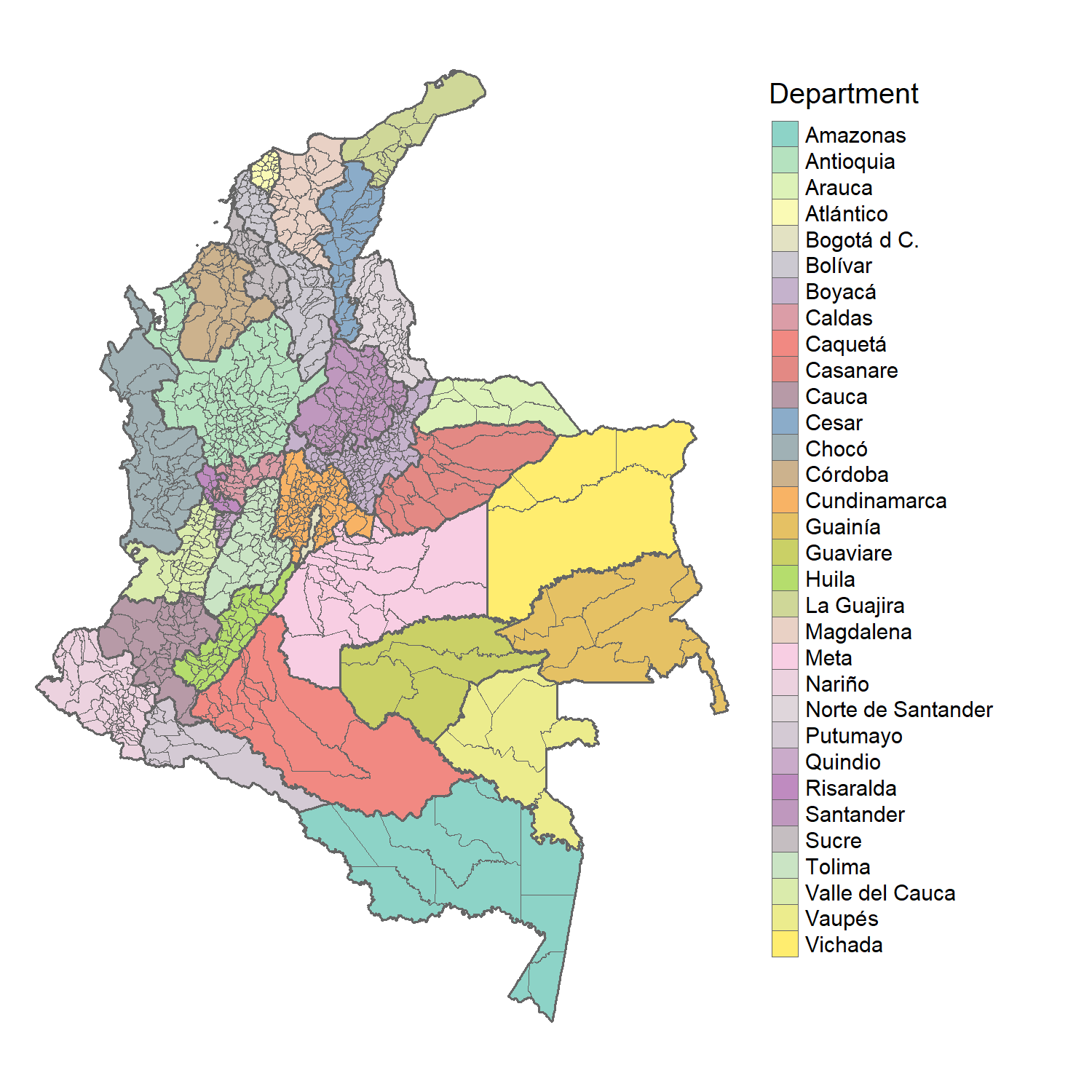 ] .pull-right[ ## Natural Regions 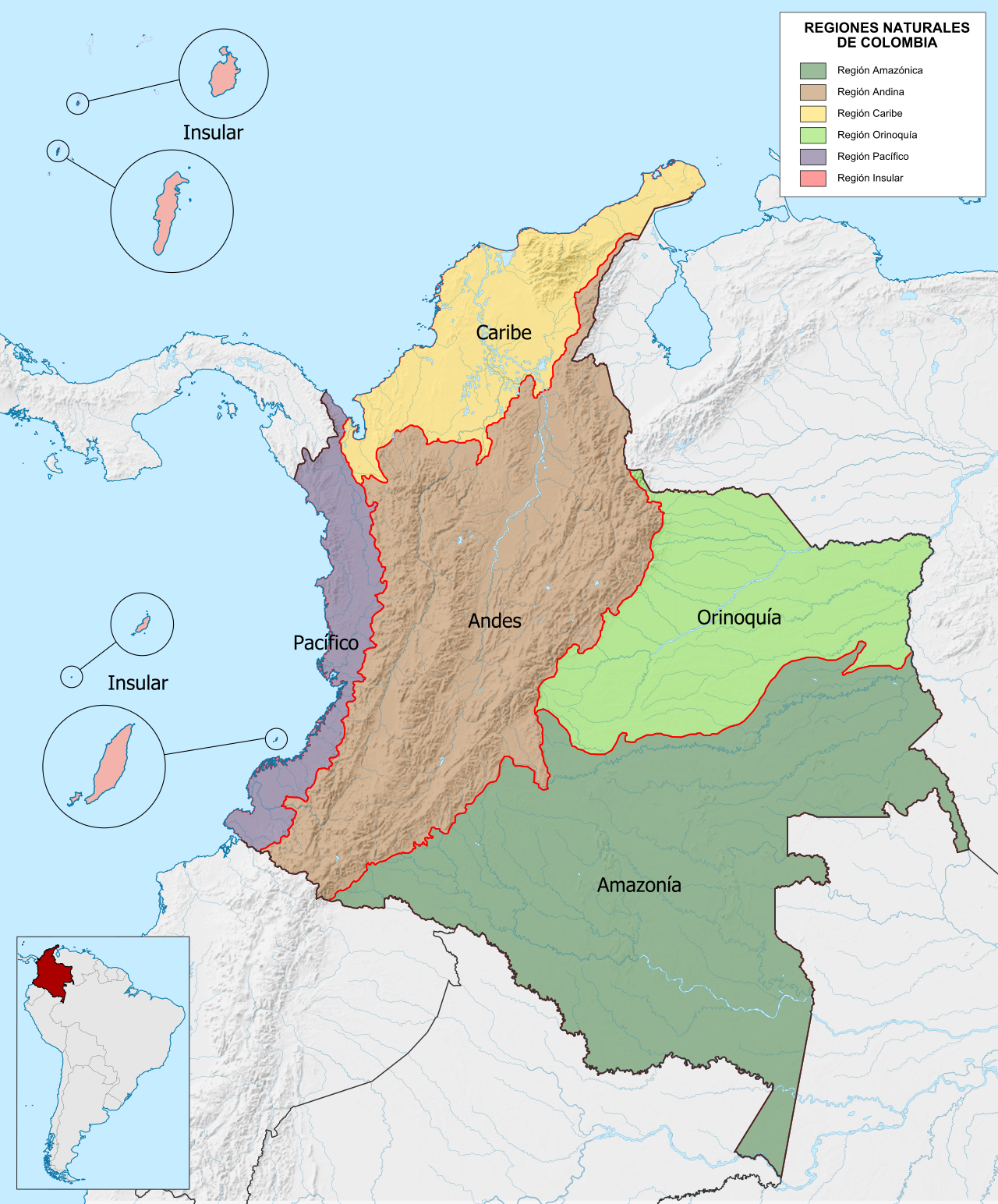 ] --- # Large regional disparities in Colombia .pull-left[ ### Well-being 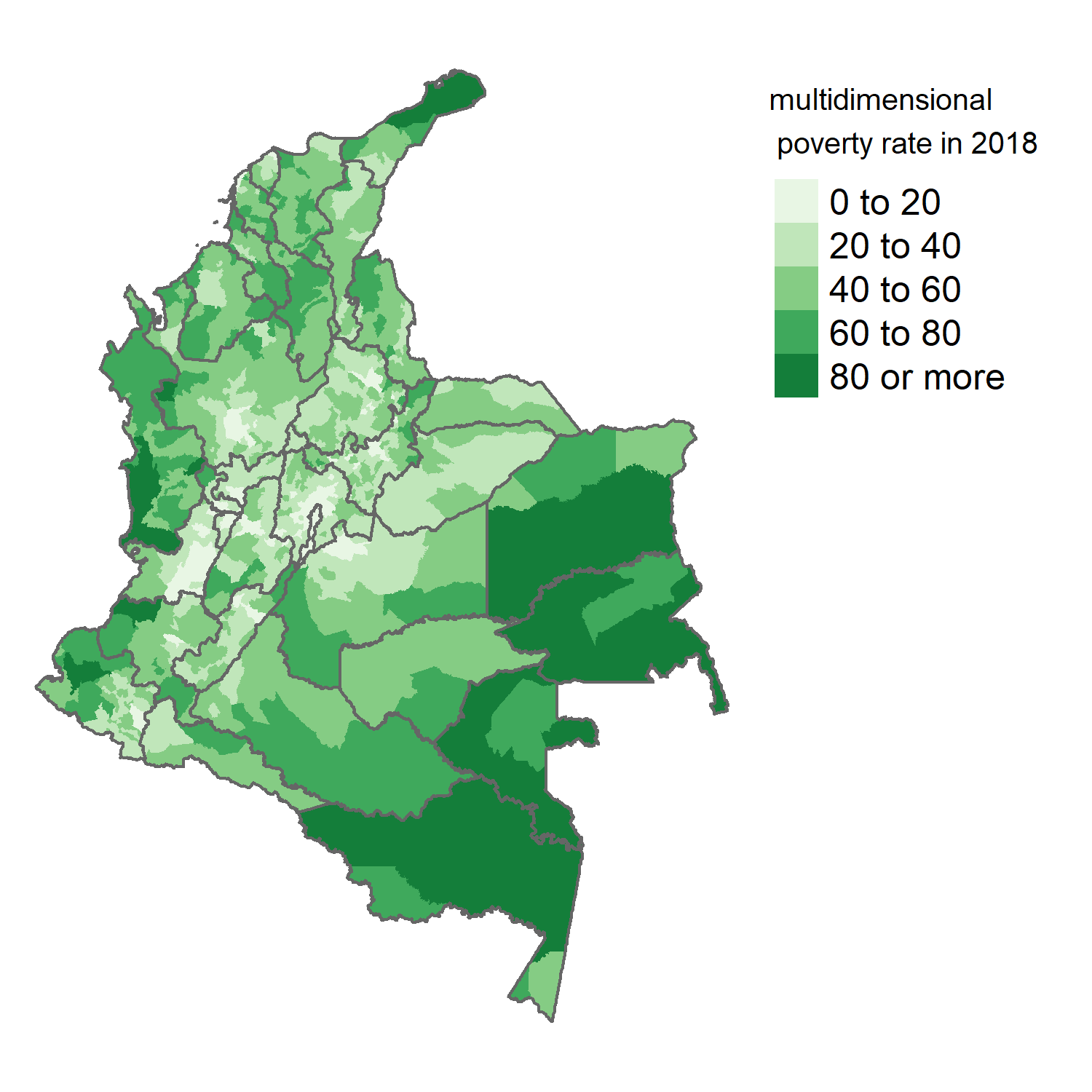 ] .pull-right[ ### Crime 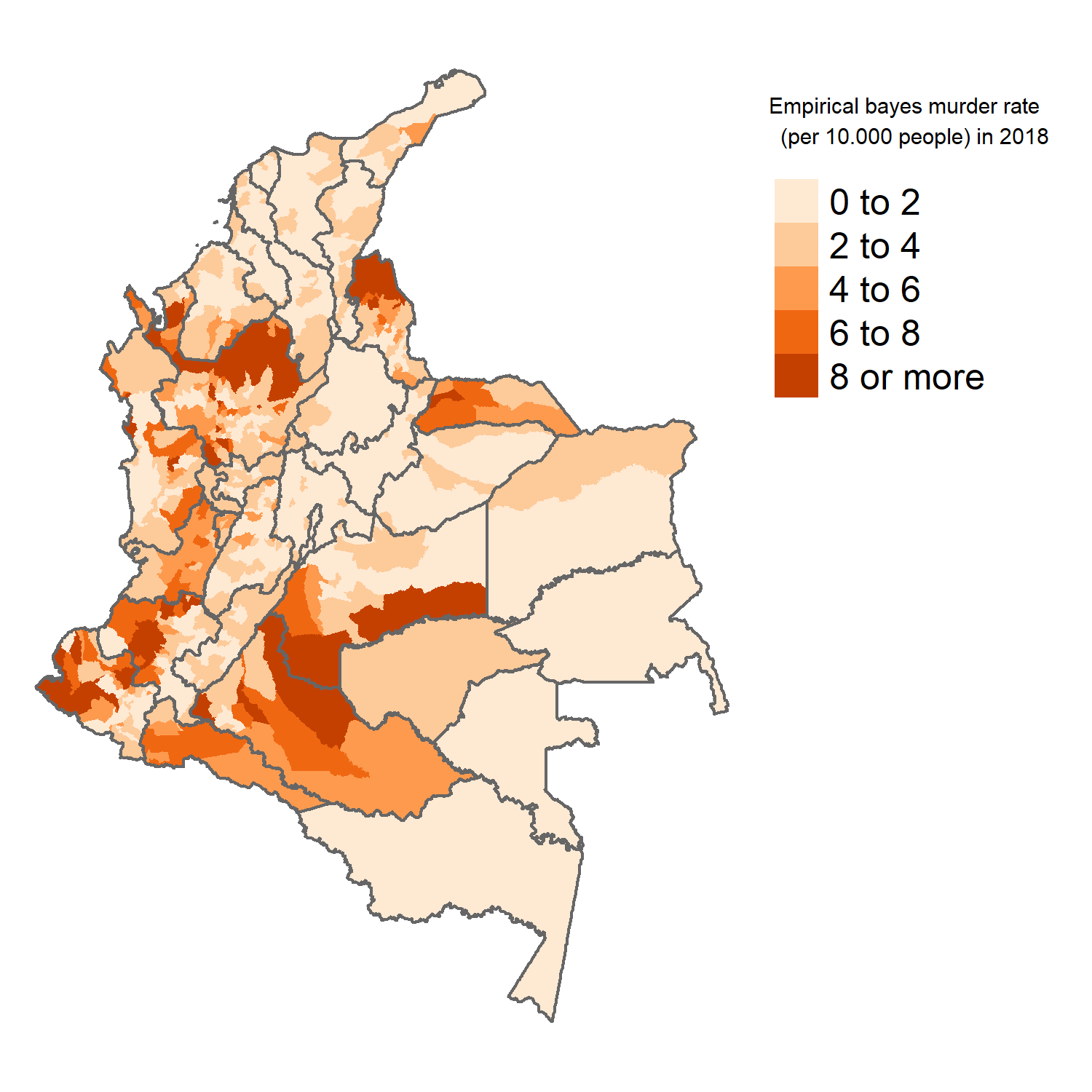 **(In Germany = about 0.1 per 10.000 people)** ] --- # Conditional Cash Transfers (CCTs) over time: <img src="figs/urrutia.png" style="width:100%"/> Figure taken from (Urrutia and Robles, 2018) --- class: ### Bayesian Model Averaging BMA - methods and results: `$$y=\alpha_{i}+X_{i} \beta_{i}+\varepsilon, \quad \varepsilon \sim N\left(0, \sigma^{2} I\right)$$` -- - **how can researchers select just a handful of determinants?** -- - **how to evaluate the importance of the inclusion of specific determinants in the model?** -- - Bayesian Model Averaging (BMA) methods attempt to overcome these problems by estimating linear models for all (**MANY**) possible combinations of determinants `\(X_{i}\)` -- .pull-left[ <img src="figs/bma.jpg" style="width:100%"/> ] .pull-right[ <img src="figs/bma2.png" style="width: 100%"/> ] --- class: center ## **212 variables** between original and spatially lagged variables were tested as determinants of 2018 homicide rates. ##**After running 2 million regressions...** <img src="figs/determinants_crime2.PNG" style="width: 100%"/> --- class: center, highlight-last-item # Synthetic control methods ## visual intuition (In terms of GDP per capita) <img src="figs/synthetic_methods.png" style="width: 55%"/> -- `$$TOKYO=0.4*OSAKA + 0.2*AICHI+0.1∗FUKUOKA+...$$` -- ### In terms of crime The weights are found so that the synthetic municipality has a similar crime trend compared to the treatment municipality (2003-2011) and similar determinants of crime. --- class: center ## Results: Synthetic control methods .pull-left[ **$$high-CCT-coverage > 70\%$$** ] .pull-right[ ** `$$low-CCT-coverage < 30\%$$`** ] -- <img src="figs/synthplot.png" style="width: 65%" /> --- class: center # The effect of CCTs on crime -- .pull-left[ **Crime gaps for treatment municipalities and control placebos** <img src="figs/gaps.png" style="width: 105%" /> ] -- .pull-right[ **Overall effects = the gap in 2018 / Root mean squared predicted error** 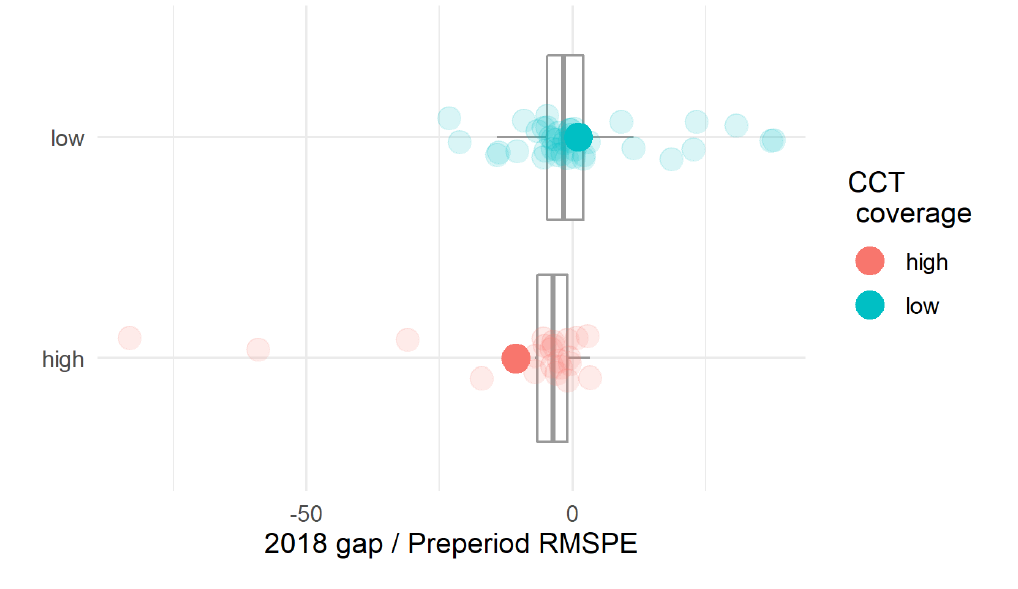 ] -- ## A t-test shows that the mean effect (lower crime) is statistically lower for the treatment group. -- The results of the synthetic controls methods are fully reproducible. https://github.com/jfsantosm/2021a-crime-ccts-colombia --- class: center ## Sensitivity analysis: Policy coverage threshold <img src="figs/sens1.png" style="width:100%"/> --- class: middle # Sensitivity analysis: in-time placebos <img src="figs/sens2.png" style="width:100%"/> - If the time of treatment is changed the effect becomes **consistently not significant**. - For instance, the p-values become larger than 0.1 if the treatment is assigned in **2008, 2006 or 2004**. --- class: highlight-last-item ### Concluding Remarks - Supporting previous studies, variables related to **inequality, literacy rates, previous crime levels, institutional capabilities, conflict and drug-trafficking** were reported as significant determinants of homicide rates. -- - By 2018, **the average homicide rates were lower for high CCT coverage municipalities** when compared to synthetic copies made out of a pool of low CCT coverage municipalities. -- ### Implications - CCT programs appear to be comprehensive policies as they can tackle multiple issues such as **poverty, low education outcomes and violence**. -- - Given funding constraints, it seems that investing in the expansion of this policy in the Pacific region can be an effective ways to improve developmental outcomes in several areas. -- - The framework of this paper can be considered a **data science framework to test the impact of regional policies** $$BMA \rightarrow \space determinants \space of\space Y \rightarrow Synethetic \space Controls \rightarrow The \space impact \space of \space X \space on \space Y $$ --- class: middle, highlight-last-item ### Further research - A dataset of determinants of crime based on previous literature (instead of the determinants found with the BMA) can be assembled. **This new dataset can be used as the input for the synthetic control analysis.** -- - **How can we integrate spatial effects and Synthetic Controls?** Spatial filtering? Adding a distance indicator as one of the determinants in the Synthetic Controls framework? --- class: middle, center # OPEN SCIENCE ##"The current state of Science in terms of transparency and openness is prompting for action... the term “reproducibility” is also gaining traction.. its definition alludes to the need of scientific results to be accompanied by enough information and detail so they could be repeated by a third party" (Rey et al. 2021) #The results of the synthetic controls methods are fully reproducible. # https://github.com/jfsantosm/2021a-crime-ccts-colombia --- class: center, middle # Thank you very much for your attention personal website: https://felipe-santos.rbind.io slides available at: https://ersa-felipe-santos.netlify.app .pull-left[  **Quantitative Regional and Computational Science lab** https://quarcs-lab.org ] .pull-right[  **Chair of International Economics Technische Universität Dresden Germany** https://tu-dresden.de/bu/wirtschaft/vwl/iwb ]